A supplier's certificate of analysis (CoA) can be one basis for accepting a raw material when it is specific to the consignment, but for raw materials at risk it is not sufficient on its own. BRCGS Food Safety Issue 9 requires acceptance to be based on the raw material risk assessment and the certificate to be specific to the consignment, and it expects assurance and testing processes for raw materials at particular risk of fraud. The IFS fraud guideline expects a business to frequently verify the supplier's results with its own analysis where the supplier did the testing. A well-built intake system checks the certificate, measures the batch, and at set intervals compares the two through laboratory confirmation.
Where do the standards place the certificate of analysis?
BRCGS Food Safety Issue 9. Clause 3.5.1.1 requires a documented risk assessment for each raw material or group of raw materials; substitution and fraud is one of its headings. The assessment forms the basis of the raw material acceptance and testing procedure. Under clause 3.5.2.1, acceptance and release for use are based on one or a combination of:
- product sampling and testing
- visual inspection on receipt
- certificates of analysis (specific to the consignment)
- certificates of conformance
The parameters for acceptance and the frequency of testing must be clearly defined, implemented and reviewed. Clause 5.4.4 requires the plan to include appropriate assurance and/or testing processes for raw materials identified in the vulnerability assessment as being at particular risk. Clause 5.6.6 requires analyses critical to product safety, authenticity or legality to be carried out by an accredited laboratory or one operating to the principles of ISO/IEC 17025, with documented justification where accredited methods are not used.
IFS. The IFS Product Fraud Mitigation Guideline (Version 3, April 2024) gives two criteria for certificates of analysis in its table of control measures: issued by an accredited laboratory, and relating to the actual batch or lot code of production. The same table states that if analytical testing is performed by the manufacturer or supplier, the business should frequently verify the results with its own analysis. The guideline also gives the reason: who owns the analysis affects how far this measure can be trusted.
FSSC 22000. The FSSC food fraud guidance lists origin and label verification, testing, supplier audits, third-party certification and specification management as examples of verification activities.
What should you check on a certificate of analysis?
When reading the certificate at the intake desk, look for answers to these questions:
- Does the batch match? The batch or lot number on the certificate must match the number on the delivered packaging and the delivery note. BRCGS asks for a certificate "specific to the consignment".
- Who did the analysis? The supplier's own laboratory, or an independent one? If independent, is that test within its accreditation scope? Not every test an accredited laboratory runs is accredited; the scope is checked against the scope document published by the accreditation body.
- Which method was used? The method or standard should be named. A result without a stated method cannot be compared with another laboratory's result.
- Which parameters are covered? Routine values such as microbiology and moisture do not answer the fraud question. Is the risk identified in the vulnerability assessment (for example substitution, dilution or false origin) actually measured on the certificate?
- Are the dates consistent? The analysis date should fit with the production and shipment dates.
- Are the values too tidy? The same value repeating exactly on every batch's certificate, or the same certificate arriving with more than one batch, are signs worth questioning.
What does a certificate of analysis not prove?
A certificate tells you about the sample that was analysed. It does not say whether that sample represents the batch in your hands; who took the sample, how, and from which batch is often not visible on the certificate. We cover what makes a sample valid in our post on sampling.
The second limit is how far routine testing reaches. BRCGS 5.4.3 lists the "sophistication of routine testing to identify adulterants" as a separate factor in the vulnerability assessment. An adulterant that the routine test package does not target may leave the values on the certificate untouched. So a product can differ from its declaration while every value on the certificate is within specification.
How do you build layered control at intake?
The raw material's risk level shapes the intake system. For a low-risk raw material, document checks may be enough; for a high-risk one, layers are added:
| Layer | What is done | What it shows |
|---|---|---|
| Document check | Certificate, delivery note and label are compared | That the paperwork is consistent |
| Batch-linked measurement | A sample from the delivered batch is measured and compared with a reference known to be correct | Whether the batch matches the expected profile |
| Laboratory confirmation | Batches that deviate, and batches selected at set intervals, go to an independent laboratory | What the deviation is, and whether the supplier's result holds |
| Supplier monitoring | Results are compared over time, supplier by supplier | When a drift began |
BRCGS 3.5.1.3 requires ongoing supplier performance review based on risk and defined performance criteria, with records kept. Batch-linked measurement results are the concrete data for that review.
Which raw material goes into which layer comes from the vulnerability assessment. We walk through how to build one in our post on vulnerability assessment.
What if the certificate and your own measurement disagree?
- Hold the batch. It is not released for use until the result is clear.
- Keep a witness sample. A sealed sample is set aside for a second analysis in case of challenge.
- Get laboratory confirmation. If your own measurement shows a deviation, targeted analysis establishes what it is.
- Talk to the supplier with concrete data. With batch number, measurement and laboratory result side by side, the subject of the discussion becomes clear.
- Update the vulnerability assessment. The IFS guideline lists non-compliant analysis results among the changes that should prompt a review of the assessment.
What changes with a new supplier or emergency supply?
BRCGS 3.5.1.7 requires product testing to be used to verify quality and safety when an exception to the supplier approval process occurs (for example, a supplier prescribed by a customer) or when information for effective supplier approval is not available (for example, bulk agricultural commodities). The IFS guideline also lists a new supplier and changes in the supply chain among the situations that call for a review of the vulnerability assessment. In these periods it makes sense to replace certificate-based acceptance with batch-linked measurement and more frequent laboratory confirmation.
Where does Molevex sit in the intake system?
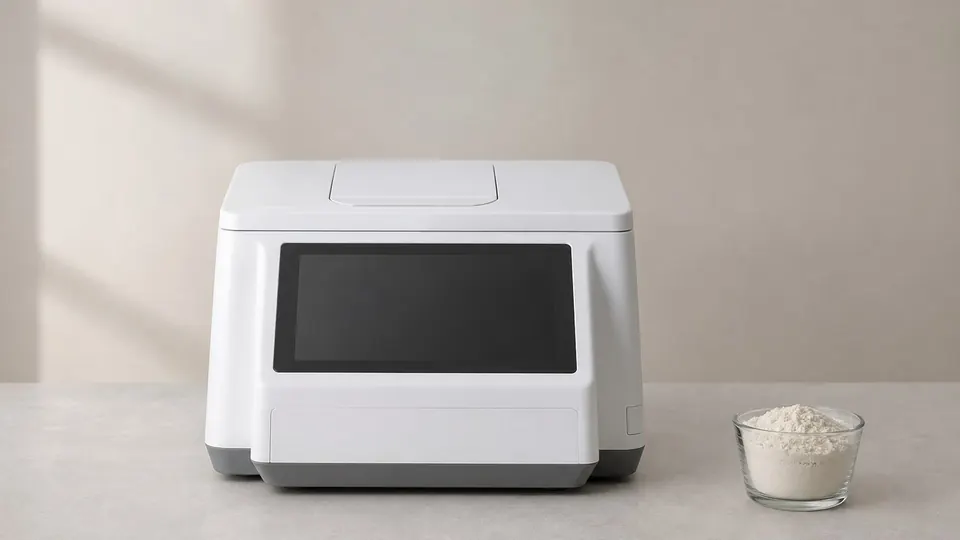
Molevex works in the batch-linked measurement layer. It adds nothing to the product; it measures the raw material's own composition and compares it with a sample you know to be correct. A sample that does not match the profile is taken up in the laboratory, and the result is confirmed there. Every result is stored linked to its batch and supplier, so a supplier's certificates and your measurements can be compared over time. Molevex does not replace official controls or an accredited laboratory report. Details specific to supplement raw materials are on the food supplements page.
Frequently asked questions
Does BRCGS accept acceptance based on a certificate of analysis? Clause 3.5.2.1 lists a consignment-specific certificate of analysis as one route to acceptance. Whether it is sufficient for a given raw material depends on the risk assessment; for raw materials at particular risk, 5.4.4 requires assurance and/or testing.
If the supplier used an accredited laboratory, do we still need our own analysis? The IFS guideline expects supplier analyses to be frequently verified by the business's own analysis. The frequency is set by the raw material's risk level in the vulnerability assessment.
Is "accredited laboratory" on the certificate enough? No. Accreditation is granted for specific tests. Whether the test on the certificate is within the laboratory's accreditation scope must be checked separately.
Do we need to send every batch to the laboratory? No. Batch-linked measurement decides which batch goes to the laboratory; in addition, batches selected at set intervals are sent for confirmation.
Can a raw material arriving without a certificate of analysis be accepted? That depends on the business's acceptance procedure and the raw material's risk assessment. BRCGS 3.5.2.1 allows acceptance to rest on one or a combination of testing, inspection and certificates; an exception not defined in your procedure should not be applied.